
Criminal Court Cases in Smith County
Smith County belongs to Tennessee's 15th Judicial District. General Sessions Court handles initial criminal proceedings, preliminary hearings, warrants and citations, and misdemeanors and traffic matters within its jurisdiction. A felony can start there and then move through the grand jury to Circuit/Criminal Court. The two courts are therefore linked, but their entries reflect different stages of the same prosecution.
The Smith County Circuit Court Clerk keeps both sets of local files. The office maintains case dates, dockets, filings, judgments, fines, and costs. That makes the clerk the key custodian when the question is what charge was filed, whether a hearing occurred, or how a count ended. The Tennessee court system directs people seeking trial-level arrest, warrant, or case information back to the clerk where the matter began.
The Tennessee courthouse directory confirms the Smith County court location. Its directory view is shown here as an official starting point for a Smith County court case lookup.
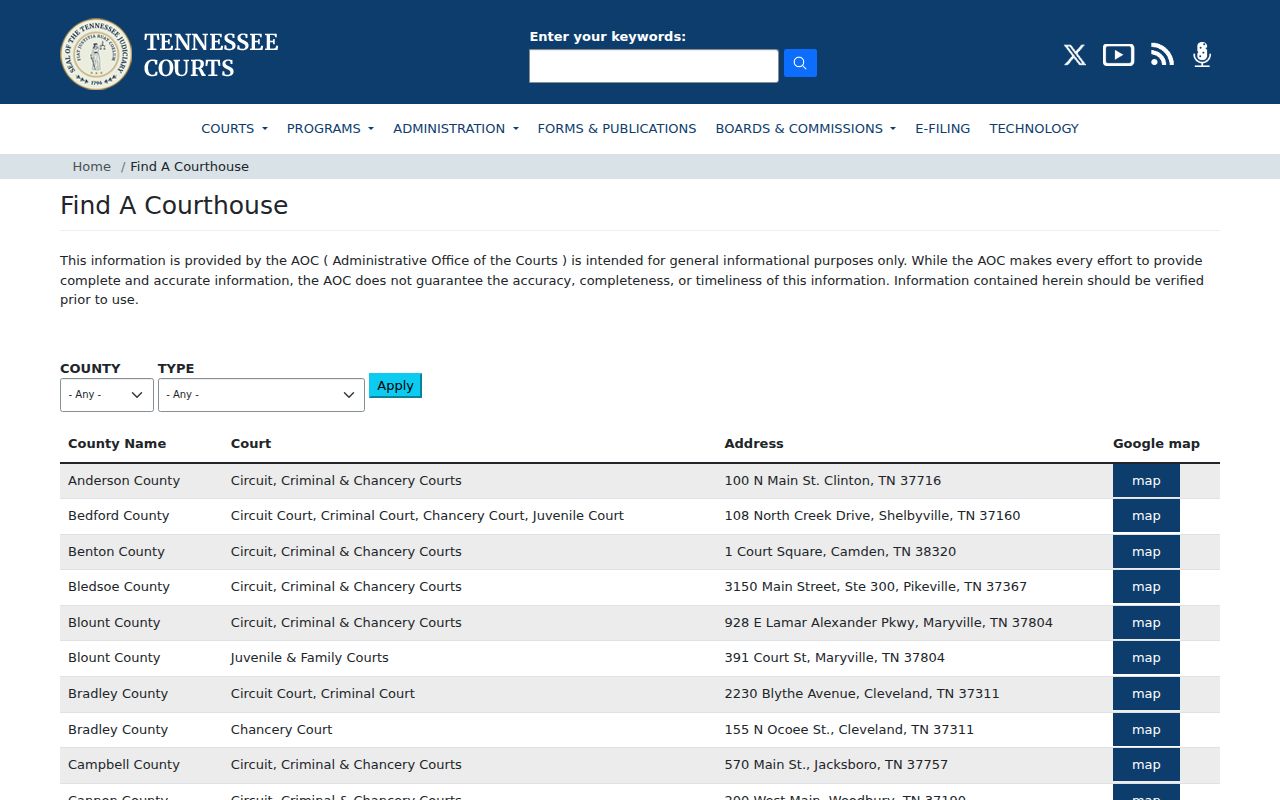
The directory helps confirm the correct county and courthouse before a caller asks the clerk to locate a criminal docket.
Two Smith County Criminal Courts
A common search error is asking for a Circuit case when the record still sits in General Sessions. Start with the charge level and procedural stage. A misdemeanor may remain in General Sessions. A felony arrest may produce General Sessions entries for the first appearance and preliminary work, then a separate Circuit/Criminal Court number after indictment.
| Court | Smith County record role | Best clue |
|---|---|---|
| General Sessions | Initial proceedings, misdemeanors, traffic, warrants, and citations | Citation, warrant, or early hearing information |
| Circuit/Criminal | Felony indictments, circuit criminal filings, dispositions, and certified copies | Indictment or Circuit case number |
Both routes lead to the same clerk's office, so a caller can ask staff to check which division holds the Smith County criminal case. That simple question prevents a false conclusion that no record exists.
Smith County Case Record Searches
No official public Smith County name-search portal was found. Case discovery therefore begins by phone or at the clerk counter. Have a full name and an approximate filing year ready. A citation or case number is even better because it identifies the division and file more precisely.
- Call the Smith County Circuit Court Clerk at 615-735-0500 and state that the request concerns a criminal case.
- Give the name, likely filing year, and any citation, warrant, or case number already known.
- Ask whether General Sessions or Circuit/Criminal Court holds the file and whether older material needs an archive search.
- Request the docket status, filed counts, disposition, and the available inspection or plain-copy options.
- Ask how to obtain a certified disposition when an official court outcome is needed. Confirm the current fee before ordering.
The Tennessee self-help clerk finder reinforces that trial-court questions go to the originating county clerk.
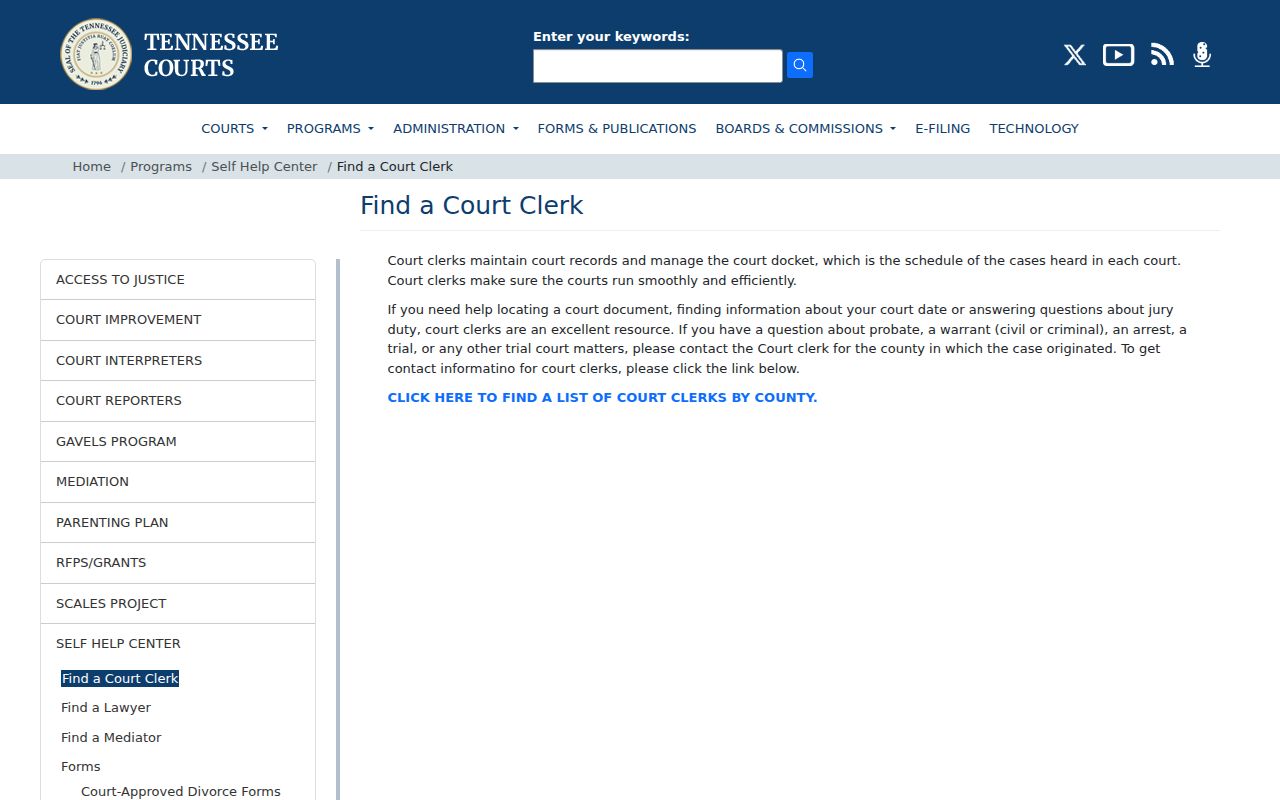
That source supports the local fallback when a statewide name search does not exist.
Smith County CourtFeePay Limits
The clerk's online payment link is useful only after a case has been identified. CourtFeePay asks the user to select General Sessions or Circuit Court and supply a citation or case number assigned by the clerk. It is not a public search by a person's name, date of birth, or broad date range.
| Field or control | Type | Required | Use |
|---|---|---|---|
| Court division | Selection | Yes | Choose General Sessions or Circuit Court |
| Citation or case number | Text | Yes | Enter the clerk-assigned identifier |
| Party name | Not offered | No | Cannot discover a Smith County case by name |
| Payment details | Payment entry | After match | Used for an identified balance, not record research |
The official payment interface appears below. Its narrow inputs show why calling the clerk is the sound first step for a Smith County court case lookup.

A payment confirmation should not be treated as a full docket or a certified disposition.
What a Criminal Case File Contains
A Smith County case file records the prosecution as it changes over time. The arrest charge can differ from the count a prosecutor files. Later entries may show an amended count, plea, trial result, dismissal, or sentence. For that reason, the judgment and disposition carry more weight than an early charge line when the aim is to understand the court's action.
| Case number and court | The division, docket identifier, filing date, case type, status, and assigned judge |
|---|---|
| Charging document | Complaint, citation, information, indictment, count, code section, and offense date when recorded |
| Docket entries | Filed motions, orders, service returns, bond events, and other chronological activity |
| Hearing dates | Initial appearance, preliminary hearing, arraignment, motions, plea, trial, and sentencing events |
| Disposition and judgment | Dismissal, nolle prosequi, acquittal, conviction, plea, verdict, or other court outcome |
| Sentence and conditions | Confinement, probation, restitution, fines, costs, and appeal or revocation entries when applicable |
Protected victim or minor details, personal identifiers, and sealed or expunged entries may be absent or redacted. The exact public display depends on the clerk's record and the law that applies.
Smith County Clerk Counter
Tommy Turner's clerk counter is listed at 322 Justice Drive, Suite 115, Carthage, Tennessee 37030. The phone is 615-735-0500, and the published weekday hours are 8 a.m. to 4 p.m. The county page also displays a different “Come see us” address at 122 Turner High Circle. Call before travel because the Justice Drive address has the stronger court-specific support.
Smith County Circuit Court Clerk
322 Justice Drive, Suite 115
Carthage, TN 37030
615-735-0500
Monday through Friday, 8 a.m. to 4 p.m.
The official Smith County clerk page describes the office's records, dates, fees, fines, and juror duties.
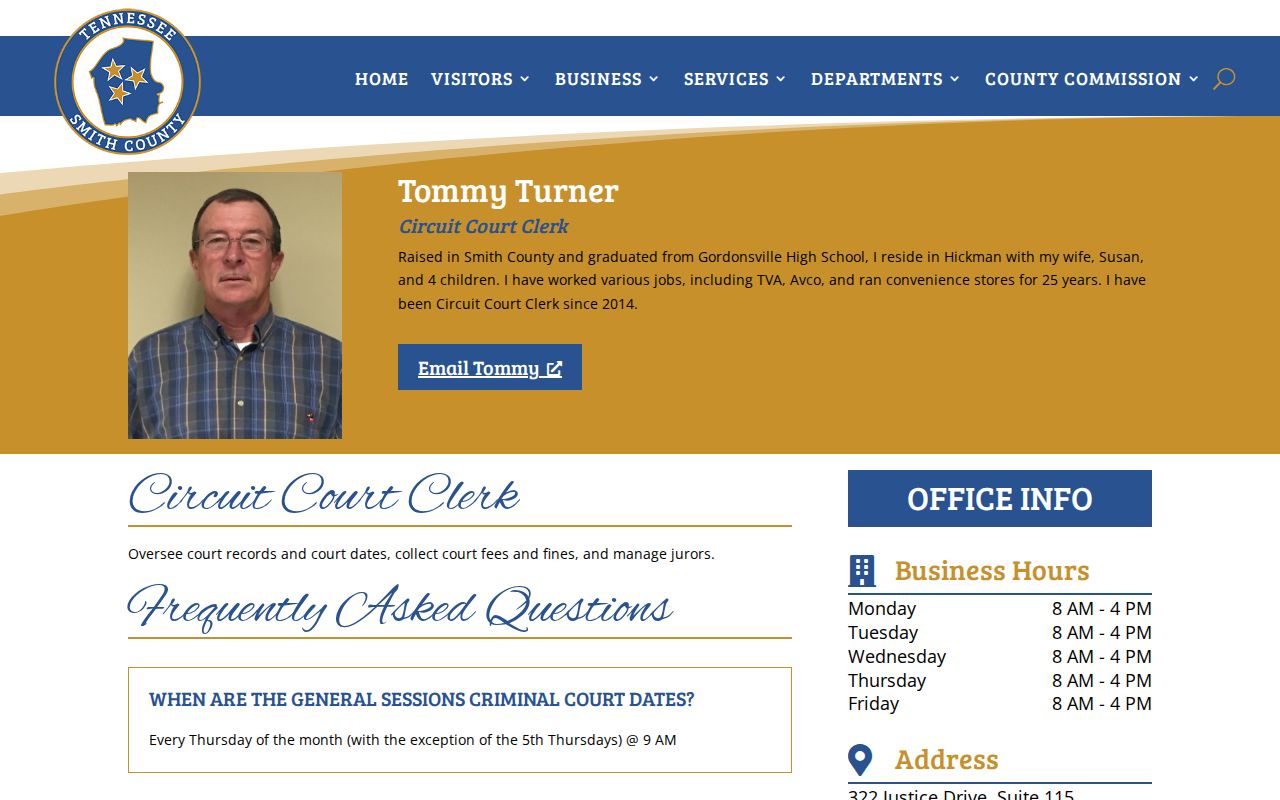
Use that contact to ask about inspection, plain copies, certified copies, archive work, and current charges for each service.
Criminal Case Stages in Smith County
A Smith County criminal case may start with a complaint, citation, or arrest warrant. The accused then has an initial appearance, and bond may be addressed. General Sessions can handle a misdemeanor within its authority or conduct preliminary felony proceedings. A grand jury may later return a true-bill indictment, creating the Circuit/Criminal Court phase.
Arraignment is the stage when the accused is advised of the filed charge and enters a plea. Pretrial work can include motions and negotiations. The case then moves to a plea or trial, followed by a disposition. Sentencing comes after a conviction, though some outcomes end without that step.
Case flow: Charges Filed › Arraignment › Pretrial › Plea or Trial › Disposition › Sentencing
Smith County General Sessions criminal court is scheduled for Thursday mornings except fifth Thursdays. That schedule is not a person-level case search. Confirm the actual hearing with the clerk before relying on a calendar pattern.
Read Smith County Court Outcomes
Short docket terms can change the meaning of a Smith County criminal record. Read the result tied to each count, not just the case caption or first charge. Several common Tennessee terms mark outcomes that do not mean conviction.
- Nolle prosequi
- The prosecution formally elects not to proceed with the charge.
- No true bill
- The grand jury does not return an indictment on the presented charge.
- Dismissal
- The charge ends without a conviction, though the reason and cost status can matter.
- Disposition
- The final or current outcome recorded for a charge or case.
- Capias
- A court order directing arrest, often after a failure to appear or comply.
Qualifying dismissals, no true bills, acquittals, and nolle prosequi outcomes may support expungement under Tennessee law. Relief is not automatic. The request is filed in the court where the Smith County matter began.
Certified Smith County Case Dispositions
A TORIS result is a fingerprint-supported Tennessee repository history, not a packet of Smith County court documents. If the goal is to prove how a local count ended, ask the Circuit Court Clerk for the judgment or certified disposition. Give the case number and identify the charge when possible. If only a name and rough year are known, ask staff to locate the file first.
Smith County has not published its copy or certification fee in the reviewed official sources. Confirm the total, accepted payment method, delivery option, and whether a self-addressed envelope is needed. For an old, sealed, or non-digitized file, ask whether staff must search paper or archived records. Keep a certified copy of an expungement order because agencies receive routed copies at different stages.
The statewide trial-court clerk directory gives another official way to verify the proper court office.
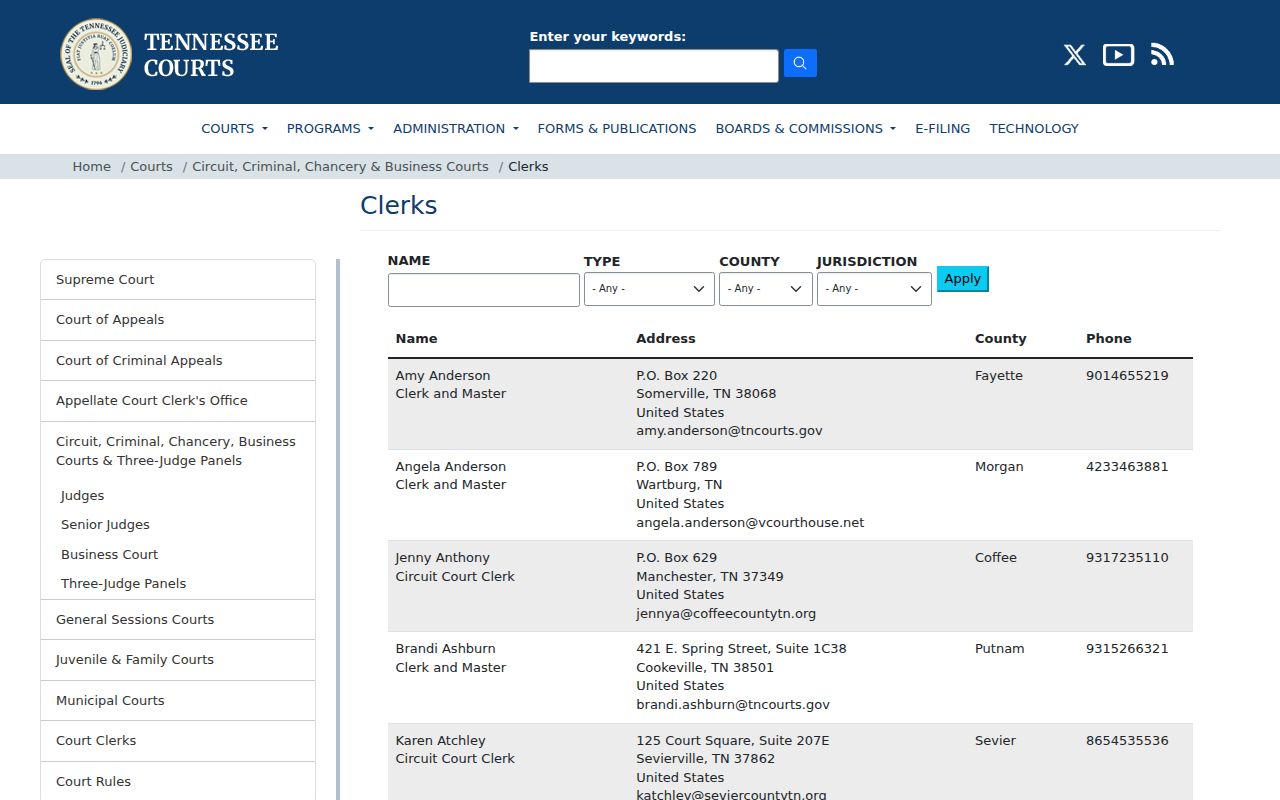
The directory confirms that local trial records remain with the county clerk rather than a single statewide name-search service.
Access Rules for Case Records
The Tennessee Public Records Act supports inspection of state and local public records, subject to specific exceptions. Tennessee Supreme Court Rule 34 also sets access policy and request procedures for judicial records within its scope. A request should go to the office that holds the file and should identify the record with enough detail for staff to find it.
Open status does not make every line public. Tennessee law can protect juvenile records, victim and minor information, personal identifiers, sealed matters, and expunged entries. Portions tied to an active investigation may also be withheld by the proper custodian. Ask for the releasable, redacted part if only some material is restricted.
A missing online result is especially weak evidence in Smith County because no official local public name search was found. Call the clerk about the originating court, an archive check, and the current inspection process. For the custody event rather than the prosecution, use the county arrest search channels.