
Smith County Criminal History Checks
Begin a Smith County criminal history check with the custodian closest to the event. A local prosecution belongs with the Smith County Circuit Court Clerk. An arrest narrative belongs with the sheriff or the city police department that wrote it. A booking entry belongs with the jail, while Tennessee's central repository draws from fingerprint submissions and reported court outcomes. Bring a full name, a rough filing or arrest date, and a case, citation, incident, or booking number when one is known. Those details help an official separate people with similar names.
There is no free local name-search portal for Smith County court or jail records. A phone call, counter request, or focused public-records request is often the first useful step. Use the following order so each result can be checked against the source document.
- Call the Smith County Circuit Court Clerk for a General Sessions or Circuit/Criminal case and ask which court holds the file.
- Ask the arresting agency for its incident or arrest report and the sheriff for booking or present-custody information.
- Use TN-FlexCheck when a Tennessee-wide, fingerprint-supported name result is useful.
- Check FOIL for felony incarceration or supervision and the TBI registry for public registration data.
- Request the underlying court judgment or a certified disposition before relying on an outcome.
Smith County Records Trail
One incident can create several Smith County records. The arresting officer makes an incident or arrest report. Jail intake creates the booking file, photograph, custody events, and fingerprint submission. General Sessions records the first court steps and many misdemeanor or traffic matters. A felony can move through the grand jury into Circuit/Criminal Court. The clerk then keeps the docket, orders, judgment, sentence, costs, and certified disposition. TBI may link the submitted arrest fingerprints to the outcome it later receives.
The practical flow is: arresting agency › county jail › Smith County courts › Tennessee Bureau of Investigation. A break in that flow matters. An event that was never fingerprinted may not reach TN-FlexCheck. A delayed or rejected disposition can leave an arrest without its final outcome in the state record. The clerk file remains the best source for what the Smith County court decided.
| Question | First custodian | Best record |
|---|---|---|
| What did the officer report? | Arresting agency | Incident or arrest report |
| Was the person booked or released? | Smith County sheriff or jail | Booking and custody file |
| How did the charge end? | Circuit Court Clerk | Judgment or certified disposition |
| What reached the state repository? | TBI | Fingerprint-supported history |
Official Background Checks in Tennessee
The Tennessee Bureau of Investigation is the state's central criminal-history repository. Its background-check overview routes the public to the correct service. TN-FlexCheck, also called TORIS, accepts public name-based requests for Tennessee history. The fee is $29 and is not refunded. Results rely on misdemeanor and felony arrests supported by fingerprints. The name search omits aliases and ordinary juvenile information, so it is not the same as identity verification by fingerprint.
Tennessee Applicant Processing Services uses IdentoGO sites for checks authorized by law. Registration requires the requesting agency's OCA code. The service and fee depend on that authorized program, and no current official listing confirmed an enrollment site inside Smith County. An individual seeking a national review of their own history can use the FBI Identity History Summary process instead. Each product answers a different question, and none supplies the local pleadings or certified judgment kept by the Smith County clerk.
The TBI background-check page is shown below. Its state guidance separates the open-records name check from authorized fingerprint channels.
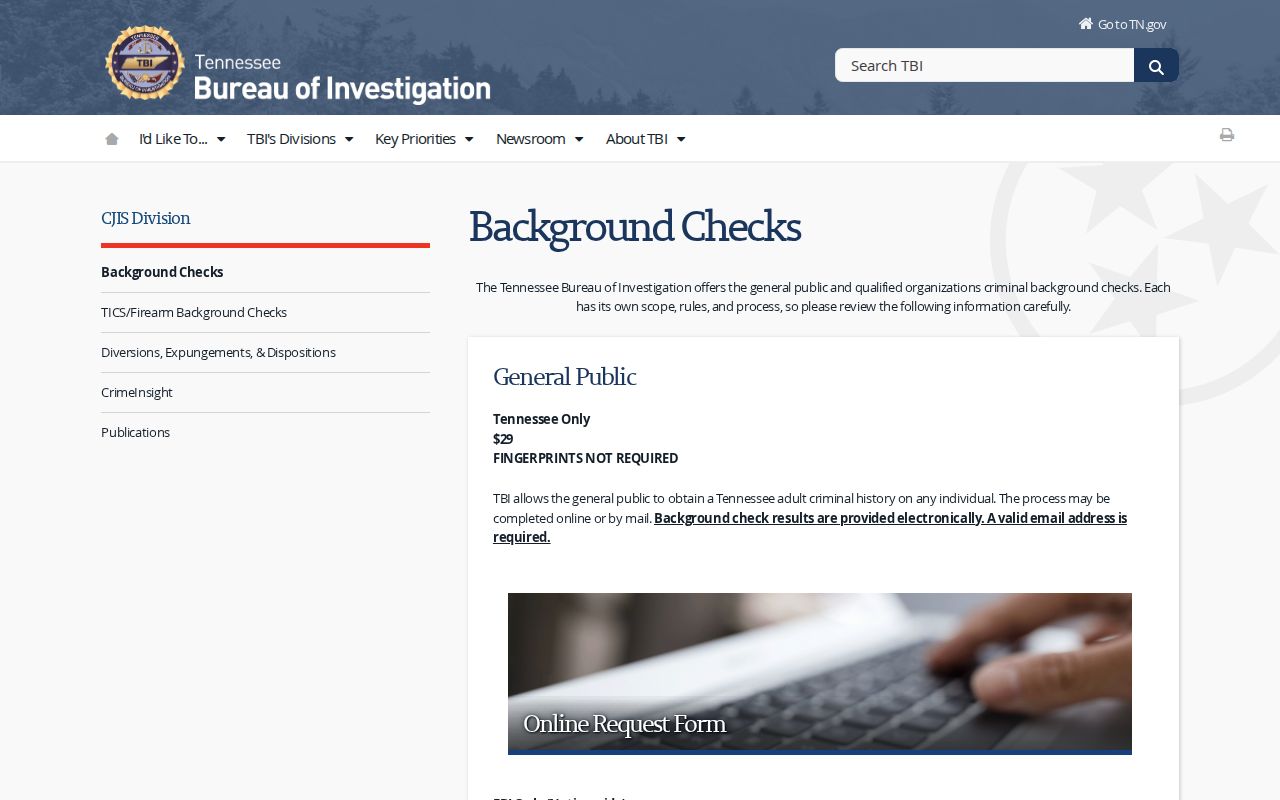
That separation helps Smith County requesters choose the official product that fits a self-review or another lawful purpose.
Smith County TORIS Record Search
TN-FlexCheck is useful when the search needs to reach beyond one Smith County file. It is not a county court database. The system searches Tennessee repository data and reports whether TBI found a potential name match. Poor or incomplete identifiers can affect the match, and the result PDF may work best on a desktop or laptop. Compare any reported Smith County event with the original clerk file because the repository may lack a linked disposition or may reflect an earlier charge.
| Request field or channel | What to enter | Access note |
|---|---|---|
| Credit card customer | One-time request path | Visa, MasterCard, or Discover; $29 |
| Requester name | First and last name | These identify the requester, not the subject |
| Requester address | Street, city, state, ZIP | Part of the request process |
| Contact details | Phone and confirmed email | The confirmation goes to the email supplied |
| Billable account | User name and password | Existing account holders only |
The official TORIS screen below is the source for the public request route.
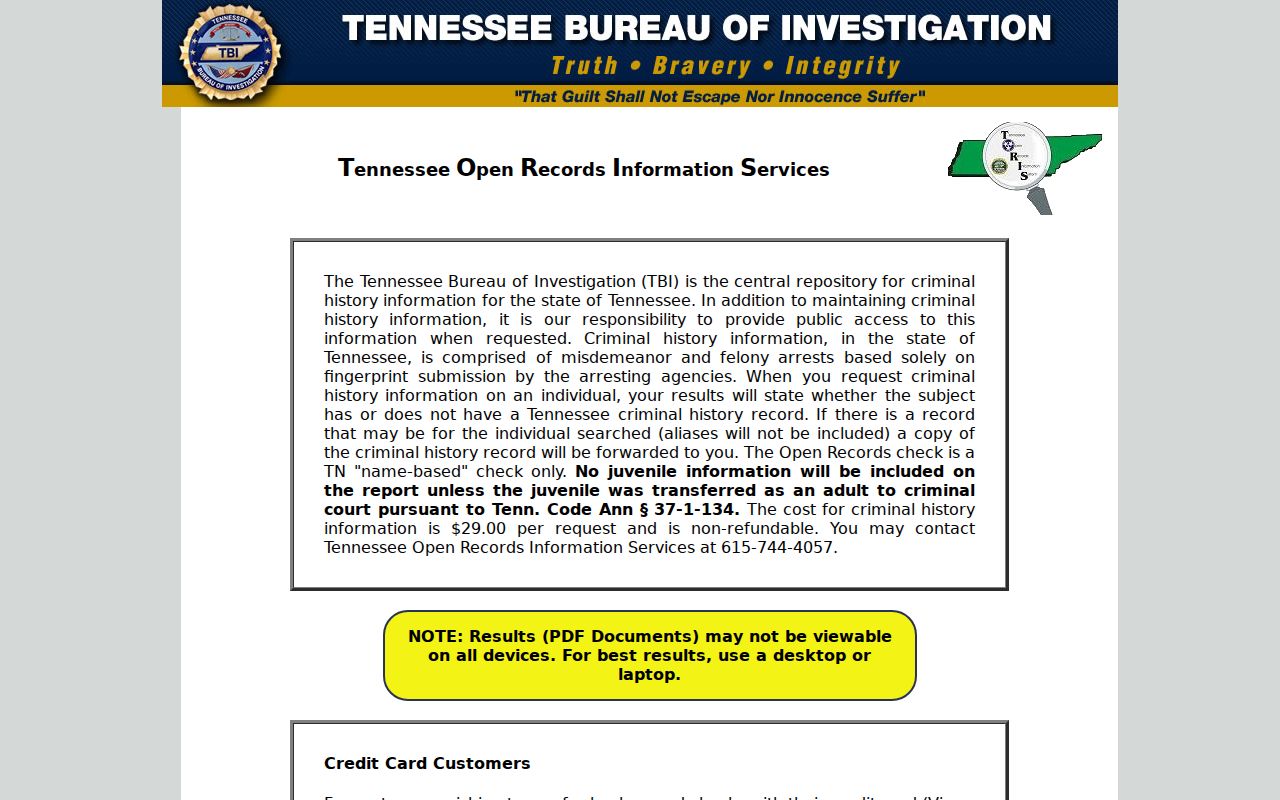
Use the requester form carefully, then verify any local match at the Smith County clerk counter.
The next screen collects requester details before payment. The TORIS terms and requester page documents those required fields.
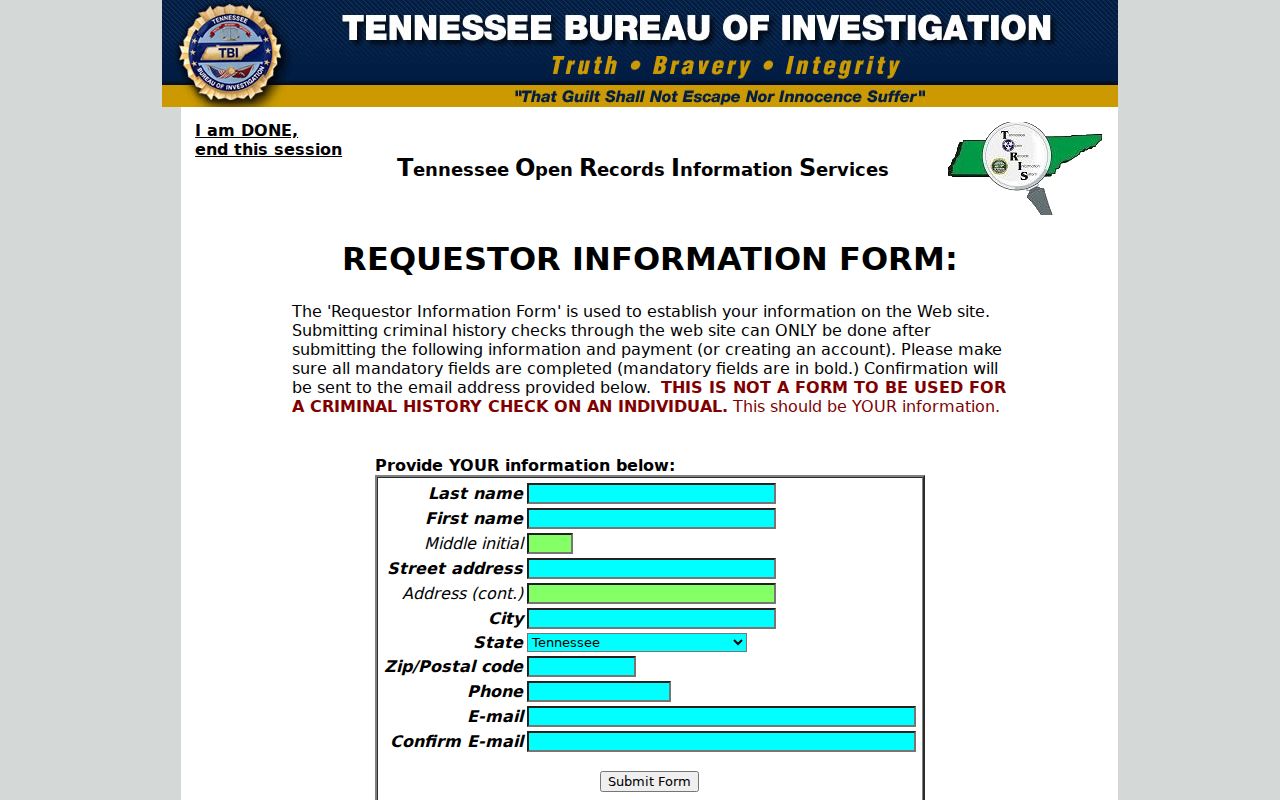
These fields should not be confused with the identifiers used to confirm that a returned Smith County record belongs to the intended person.
Kinds of Criminal Records
Smith County criminal records are grouped by the office and stage that created them. A police narrative records what was reported and investigated. A booking record documents custody. A court file records the prosecution and result. TBI compiles fingerprint-supported arrest cycles with outcomes sent by clerks or agencies. FOIL covers felony custody and supervision through the Tennessee Department of Correction. The public sex offender registry is a separate safety database based on registration information.
- Incident and arrest reports: kept by the sheriff, city police, Highway Patrol, or other arresting agency.
- Booking records: jail intake details, holding charges, bond, release, photograph, and fingerprints.
- Court records: complaints, warrants, indictments, motions, pleas, judgments, sentences, and costs.
- State repository records: Tennessee fingerprint-supported cycles and linked dispositions reported to TBI.
- Custody and registry records: TDOC status through FOIL and public registration data through TBI.
A warrant is also its own record layer. The issuing court and the agency charged with service may hold different status details. No official public Smith County warrant database was found, so current confirmation must come through the clerk and sheriff.
Smith County Fingerprint Record Review
A name match and a fingerprint match are not equal. TN-FlexCheck offers a convenient Tennessee name route, but fingerprints tie the review to one person. TBI's published accuracy-dispute process calls for fingerprints, a dispute letter, and a $24 cashier's check or money order for comparison. The Biometric Services Unit handles confirmed repository inaccuracies. This process addresses the state record, not a wrong entry in the Smith County court docket.
TAPS uses IdentoGO electronic fingerprint sites for checks backed by a Tennessee law or authorized agency. The requesting body provides the OCA code used to register. One state program page gives 855-226-2937 for scheduling help, but Smith County residents should use the live appointment locator rather than assume Carthage has a current collection site.
The Tennessee fingerprint instructions provide the official appointment workflow.
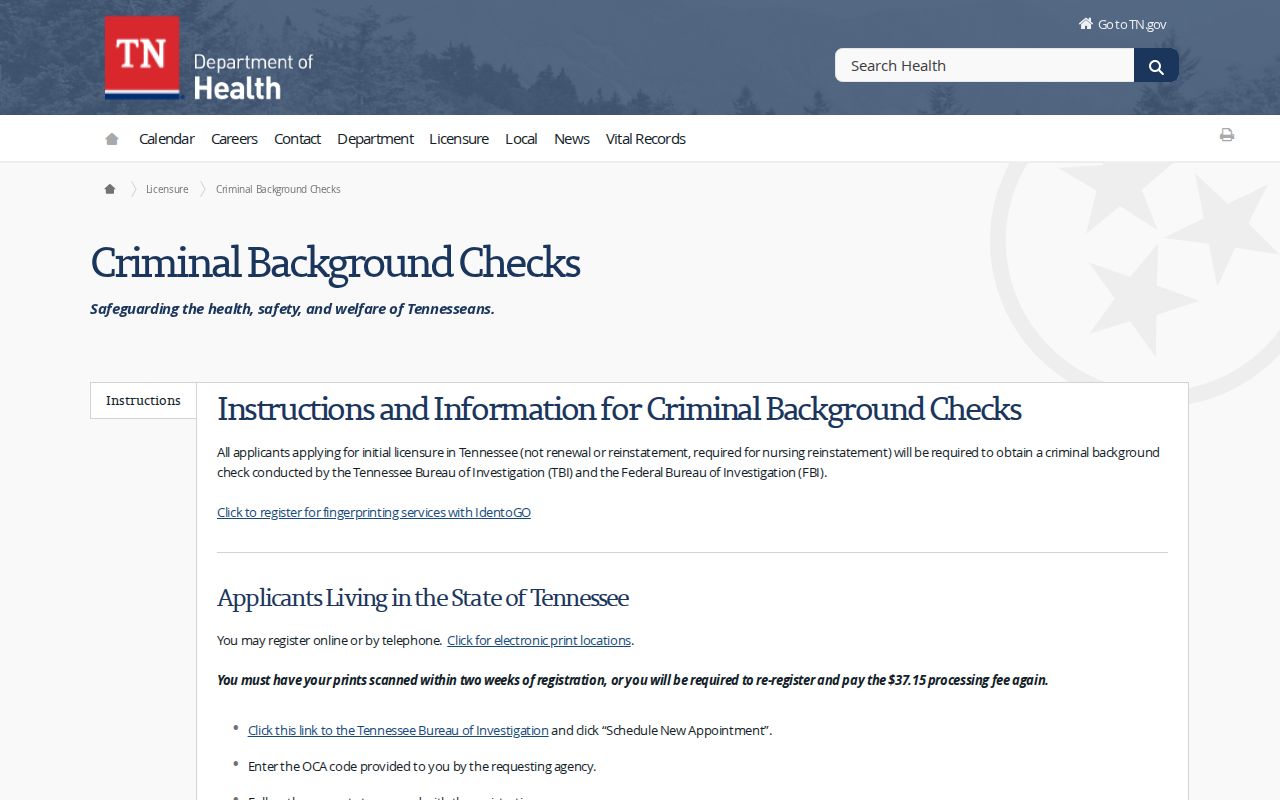
The scheduler confirms the site and program-specific charge after the authorized service code is entered.
For a national personal record, the FBI Electronic Departmental Order portal accepts an Identity History Summary request with fingerprints.
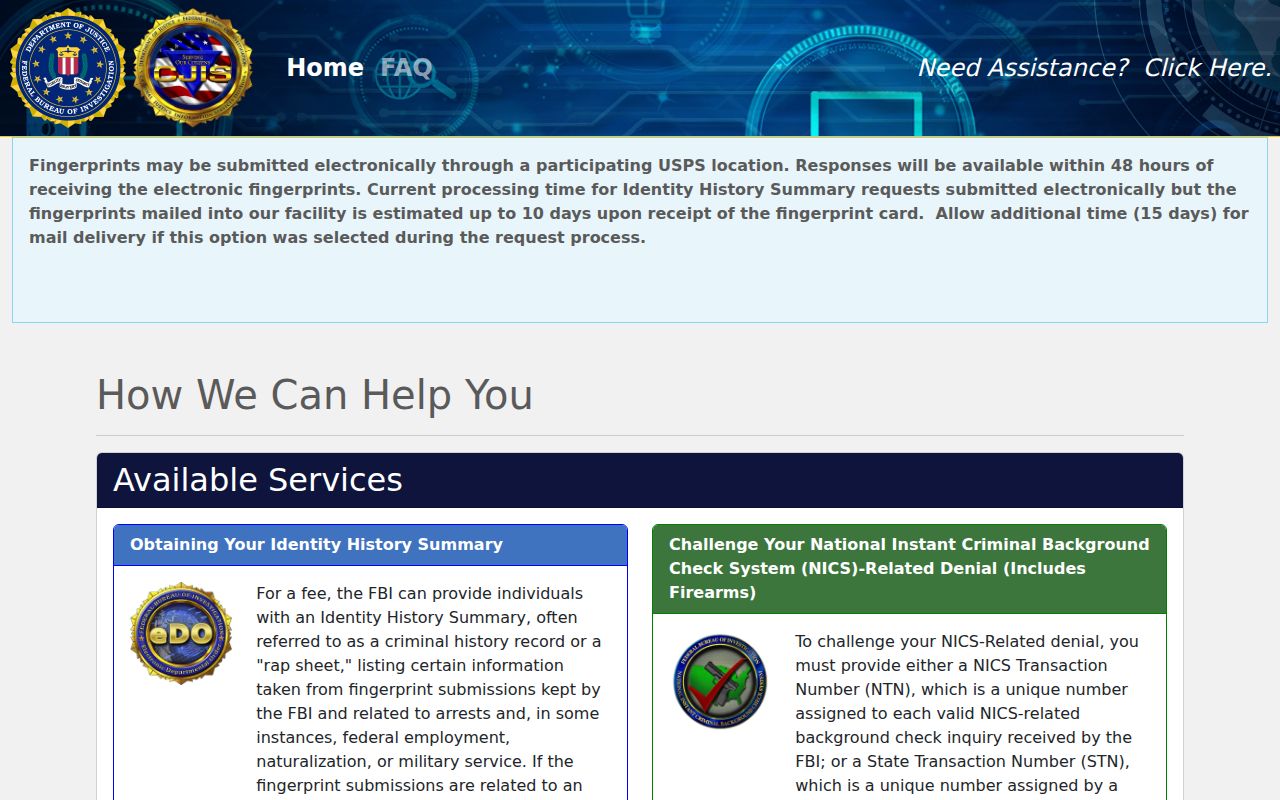
That federal summary is broader than a Tennessee name search but still does not replace the underlying Smith County case file.
Smith County Criminal Records: What They Contain
The fields change with the record source. A Smith County booking sheet focuses on intake and custody. The court file follows the case. A TBI history organizes fingerprint-supported events by arrest cycle and reported outcome. Reading the source label first prevents a common error: treating a charge listed at booking as though it were the final conviction.
| Name & identifiers | Name, aliases when held by that source, date of birth, and physical or agency identifiers. |
|---|---|
| Arrest & booking data | Arresting agency, booking number and time, holding charges, bond, holds, release, and intake details. |
| Charges & statutes | Charge text, Tennessee Code citation, count number, and felony or misdemeanor class. |
| Disposition | Plea, trial result, dismissal, nolle prosequi, no true bill, or other current outcome. |
| Sentence | Confinement, probation, fines, costs, restitution when ordered, and related judgment terms. |
| Custody or supervision | County custody events or TDOC incarceration, probation, parole, or inactive status. |
- Disposition
- The final or current outcome recorded for a charge or case.
- Nolle prosequi
- A formal choice by the prosecution not to proceed with the charge.
- Capias
- A court order directing an arrest, often after failure to appear or comply.
- Certified disposition
- A clerk-certified court record showing the outcome entered in the case.
Smith County Custody Record Layers
The county jail, FOIL, and VINE answer separate custody questions. A new Smith County booking may remain only in local records and may never appear in FOIL if the person is not placed in TDOC felony custody or supervision. FOIL can show a TDOC photo, status, location, offense, sentence, release information, and parole-hearing details. VINE provides custody search and notifications, but it is not a certified court record.
Use the sheriff for current county custody, the Circuit Court Clerk for the charge and judgment, and TDOC FOIL for felony incarceration, probation, parole, or inactive status. A federal sentence belongs in the federal Bureau of Prisons locator. Crossing those layers can produce a false no-record result.
Smith County also operates misdemeanor probation and Recovery Court from the Justice Center. Recovery Court meets on Wednesday mornings and combines court contact, treatment, supervision, meetings, assessment, and drug screens for eligible nonviolent cases linked to substance misuse. Felony community supervision is state-run through TDOC District 31 in Cookeville.
Tennessee Public Access Laws
The Tennessee Public Records Act generally supports inspection of state and local public records, but access begins with the correct custodian. The Smith County sheriff cannot certify a Circuit Court judgment, and the clerk does not own a Carthage police narrative. A request should name one record, date range, agency, and identifying number when possible. Officials may redact juvenile material, protected victim details, personal identifiers, sealed information, and protected parts of an active investigation.
Key Tennessee rules:
Tenn. Code Ann. § 10-7-503 sets the basic right to inspect public records, subject to law.
Tenn. Code Ann. § 10-7-504 collects confidentiality rules and exceptions that can require withholding or redaction.
Tenn. Code Ann. § 40-32-101 governs removal of qualifying criminal records through expungement.
Tenn. Code Ann. § 37-1-153 protects juvenile files, subject to stated exceptions.
Tenn. Code Ann. § 40-39-206 governs the central registry and its public information.
Inspection rights do not turn every line into a public fact. Ask for a releasable redacted copy when part of a Smith County record is protected.
Smith County Warrant Record Gaps
No official public Smith County active-warrant database was located. CourtFeePay does not fill that gap because it requires a court choice and a citation or case number. For a bench capias or case-linked warrant, call the Circuit Court Clerk at 615-735-0500. For service or safe verification, contact the Smith County Sheriff's Office and ask for its current procedure. Investigative or sealed warrants may not be open to confirmation.
A warrant record can list a name, case number, charge, issuing court, date, bond, service return, and current status. Court and sheriff systems may update at different times. Confirm again after a recall, appearance, payment, or service. Anyone who thinks a warrant may be active should speak with a qualified Tennessee lawyer before appearing at an office. Never send money because of an unexpected warrant call; use a number independently confirmed through an official source.
Restricted, Sealed & Expunged Records
Tennessee expungement can remove qualifying records from ordinary public access. Free-eligible results listed by Tennessee Courts include dismissals, no true bills, release without charge, not-guilty verdicts, nolle prosequi, and certain successful protection-order defenses. The request is filed in the court where the matter began. Smith County applicants should first obtain the docket and charge data from the clerk, identify every eligible count, and ask for the current packet.
Some qualifying misdemeanor, Class E felony, or diversion outcomes use a petition process. Eligibility depends on the offense and prior history. TBI guidance has quoted a $180 state expungement fee plus local court costs for certain conviction relief, while qualifying non-conviction outcomes may be free. A retired charge must first reach dismissed status, and costs on a dismissal may need to be paid or waived. Juvenile records are governed by separate confidentiality rules.
Smith County Expungement Record Route
The filing point is the Smith County Circuit Court Clerk at 322 Justice Drive, Suite 115, Carthage. Call 615-735-0500 to confirm whether General Sessions or Circuit holds the case and which form is current. Tennessee Courts advises applicants who mail material to include a self-addressed stamped envelope for each charge when they want returned copies. Ask for certified copies of the order and charging document, then keep them.
After the judge and clerk complete a qualifying order, it is routed to agencies that may hold the record, including the arresting agency, county jail, TDOC, and TBI. That routing explains why a dismissal does not vanish from every system on its own. A missing transaction link or rejected submission can leave stale state data. Certified proof gives the requester a sound basis for follow-up with the record holder.
Smith County Court Record Schedule
The Smith County Circuit Court Clerk keeps the public counter at 322 Justice Drive, Suite 115, Carthage, TN 37030. The phone is 615-735-0500, and posted hours are Monday through Friday from 8 a.m. to 4 p.m. General Sessions criminal matters are scheduled at 9 a.m. each Thursday except a fifth Thursday. Traffic is set for the first and third Tuesday mornings. A docket schedule is not a name search, so confirm a specific date with the clerk.
The county page also displays a separate “Come see us” address at 122 Turner High Circle. The detailed clerk listing and Tennessee courthouse directory support Justice Drive for the court counter. Call before travel. The official Smith County site pictured below is the starting point for current county department information.

Current office details should be confirmed there or with the clerk, especially when two published address lines conflict.
City-by-City Criminal Records in Smith County
City police records remain with the city that created them, even when later steps move into county and state systems. Carthage, South Carthage, and Gordonsville each have a distinct police channel. Booking generally moves to the Smith County sheriff, prosecution to General Sessions or Circuit/Criminal Court, and fingerprint-supported history to TBI. Start with the agency named on the report rather than assuming that all records near the county seat belong to the same office.
Carthage Record Check
2020 population 2,291 · Police and City Court share the 314 Spring Street town office.
South Carthage Record Check
2025 certified population 1,490 · Its police records are separate from neighboring Carthage records.
Gordonsville Record Check
2025 certified population 1,363 · Town Hall, police, and City Court use 63 East Main Street.
The FBI Crime Data Explorer shown below is the official source for agency and county crime data.

Use one agency and year at a time, and never combine offenses known, arrests, and convictions into a single Smith County measure.